 jane
The legal history of cannabis in the United States traces a path from widespread agricultural and medicinal use in the 19th century, through federal prohibition beginning in 1937, to a patchwork of state-level reforms that continue to evolve today. Understanding this trajectory is essential for cannabis professionals navigating North American markets, particularly as cross-border trade remains federally restricted despite significant state-level policy shifts.
Cannabis grew freely across the United States until the early 20th century, cultivated primarily for hemp fiber and documented in agricultural records from colonial times forward. The substance appeared in the U.S. Pharmacopeia until 1942, recognized for various therapeutic applications. This changed dramatically with the Marihuana Tax Act of 1937, which imposed prohibitive licensing fees and taxes that effectively ended legal cultivation, manufacturing, and distribution. The act marked the beginning of cannabis prohibition at the federal level, eliminating both the commercial hemp industry and medicinal cannabis markets.
The Controlled Substances Act of 1970 cemented cannabis as a Schedule I narcotic, a classification that remains in effect federally and continues to shape interstate commerce, banking, taxation, and employment practices across the industry. For Canadian cannabis retailers examining U.S. market opportunities, this federal prohibition creates unique compliance challenges that differ substantially from Canada’s nationally regulated framework.
Since California’s Proposition 215 in 1996, individual states have begun carving out legal medical and adult-use markets, creating a complex regulatory environment where state law conflicts with federal statute. This legal fragmentation directly impacts everything from agricultural documentation and yield tracking to employment standards and cross-border compliance requirements that remain critical considerations in 2026.
Early Legal Status and Agricultural Use (Pre-1900s to 1930s)

From America’s founding through the early 1900s, cannabis grew freely across the country without legal restriction. Farmers cultivated hemp, the fibrous variety of Cannabis sativa, as an ordinary agricultural commodity, much like wheat or corn. The plant served essential industrial purposes: its strong fibers became rope for ships, textiles for clothing and sacks, and paper. Colonial governments sometimes encouraged hemp cultivation to supply naval stores, and George Washington famously grew hemp at Mount Vernon.
During this period, cannabis appeared in agricultural records alongside other cash crops. Farmers documented hemp yields in pounds per acre, tracking productivity just as they would for any commercial crop. These early yield records focused purely on fiber output, with little attention to the plant’s psychoactive properties. While cannabis extracts appeared in some patent medicines by the late 1800s, hemp cultivation remained primarily an agricultural enterprise rather than a pharmaceutical or recreational concern.
The crop’s legal status stayed unrestricted into the 20th century. No federal or state laws prohibited growing, selling, or possessing cannabis. Agricultural extension services published hemp cultivation guides, and universities conducted research on optimal growing conditions and fiber quality. Yield documentation from this era provides valuable baseline data showing hemp’s agricultural performance before prohibition disrupted domestic production.
This regulatory vacuum began shifting in the 1910s and 1920s as some states passed laws targeting cannabis’s psychoactive use, often driven by xenophobia and racial prejudice rather than agricultural concerns. These early state restrictions focused on recreational consumption, not industrial hemp farming. However, they signaled the beginning of a legal transformation that would soon collapse the distinction between hemp and marijuana, ultimately ending nearly two centuries of legal cannabis cultivation and halting systematic yield record collection for decades.
The Path to Federal Prohibition (1930s-1970)

The Marihuana Tax Act of 1937 marked the federal government’s first major step toward cannabis prohibition. Introduced by Harry Anslinger, commissioner of the Federal Bureau of Narcotics, the legislation imposed strict regulations and prohibitive taxes on cannabis cultivation, sale, and possession. While technically leaving cannabis legal, the Act’s complex registration requirements and steep penalties made legitimate participation in the cannabis trade nearly impossible for farmers and businesses.
The Act’s passage relied heavily on sensationalized claims about cannabis’s dangers, often rooted in racial prejudice and anti-immigrant sentiment rather than scientific evidence. Congressional hearings featured little testimony from medical professionals or agricultural experts who might have challenged the narrative. The American Medical Association opposed the legislation, arguing that cannabis had legitimate medical applications and that the tax scheme would hinder research, but these objections carried minimal weight against the political momentum Anslinger had built.
For cannabis cultivators and researchers, the practical effect was immediate and severe. Hemp farmers who had maintained detailed yield records for crop rotation and seed selection found themselves unable to continue legal production. Agricultural experiment stations that had documented cannabis performance across different growing conditions ceased their research programs. The systematic collection of yield data that had characterized American hemp agriculture since colonial times came to an abrupt halt.
The Controlled Substances Act of 1970 completed the prohibition framework. This comprehensive federal drug law placed cannabis in Schedule I, a classification reserved for substances with high abuse potential, no currently accepted medical use, and a lack of accepted safety for use under medical supervision. The scheduling decision ignored recommendations from some scientific advisors and formalized cannabis’s status alongside drugs like heroin.
Schedule I classification carried profound consequences for agricultural research and data collection. Federal research permits became exceptionally difficult to obtain, limited to a single government-approved cultivation facility, and restricted to studies investigating abuse potential rather than cultivation optimization or medical benefits. The agricultural yield records that had once helped farmers maximize hemp fiber production became relics of a bygone era. This regulatory environment remained largely unchanged for decades, creating what researchers now recognize as a critical gap in cannabis agricultural knowledge that modern cultivators have worked to rebuild through state-legal programs.
State-Level Medical Cannabis Reforms (1996-2012)
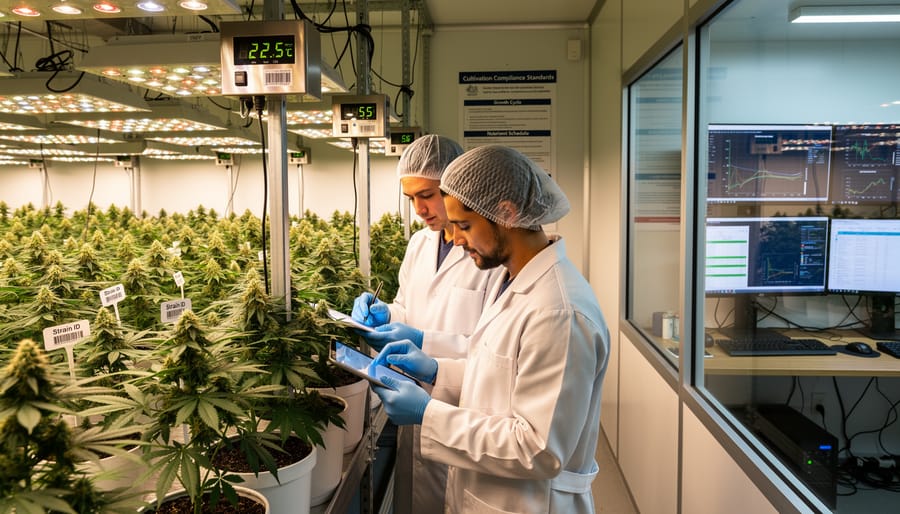
California’s 1996 Proposition 215, also called the Compassionate Use Act, marked the first modern legal challenge to federal cannabis prohibition. The ballot measure allowed patients with physician recommendations to possess and cultivate cannabis for medical purposes, creating the first state-level legal framework for cannabis production since the 1930s. While the initiative passed with 55% voter support, it provided limited regulatory structure, no licensing requirements, cultivation limits, or standardized testing protocols existed in the initial years.
The lack of clear regulations in California’s early program created enforcement challenges and compliance ambiguity. Patients could designate caregivers to grow on their behalf, but without defined plant counts or possession limits, law enforcement struggled to distinguish legal medical use from illegal activity. This regulatory gap meant no systematic tracking of cultivation volumes, plant yields, or product potency during the program’s first decade.
Other states watched California’s experiment closely before crafting their own medical cannabis frameworks. Oregon, Washington, and Alaska passed medical programs in 1998, followed by Maine in 1999 and Hawaii in 2000. These second-wave programs incorporated lessons from California’s loose structure: most established patient registries, set specific possession and plant count limits, and created clearer definitions of qualifying medical conditions.
The progression continued through the 2000s as additional states authorized medical cannabis. Nevada, Montana, and Vermont joined between 2000 and 2004. Rhode Island became the first state to pass medical cannabis legislation through its state legislature rather than ballot initiative in 2006, signaling growing political acceptance. Michigan’s 2008 voter-approved program brought medical cannabis to the Midwest, while Arizona, New Jersey, and Delaware established programs by 2011.
These expanding medical frameworks reintroduced the need for agricultural documentation and yield tracking that had disappeared during prohibition. States began implementing seed-to-sale systems requiring cultivators to report plant counts, harvest weights, and product batches. Colorado’s 2010 medical regulations mandated comprehensive inventory tracking through the state’s MITS system, creating the first substantial yield database since prohibition ended legal record-keeping. New Mexico and Maine developed similar compliance systems tracking plants from cultivation through dispensary sales.
By 2012, seventeen states had implemented medical cannabis programs with varying degrees of regulatory oversight. This patchwork of state-level systems created the foundation for more comprehensive adult-use legalization while rebuilding the agricultural data infrastructure that federal prohibition had eliminated for seven decades.
Adult-Use Legalization Era (2012-Present)
Colorado and Washington broke new ground on November 6, 2012, when voters approved Amendment 64 and Initiative 502 respectively. These ballot measures established the first legal frameworks for adult-use cannabis sales in the United States since federal prohibition began. Colorado’s market opened to consumers on January 1, 2014, followed by Washington’s retail launch in July 2014. Both states implemented comprehensive regulatory systems requiring licensed cultivators, processors, and retailers to document every plant from seed to final sale.
The regulatory infrastructure developed during this initial phase set precedents that shaped subsequent state programs. Colorado’s Marijuana Enforcement Division and Washington’s Liquor and Cannabis Board created mandatory inventory tracking systems that captured cultivation data at an unprecedented scale. Licensed growers had to report plant counts, harvest weights, processing yields, and batch-specific testing results. This regulatory requirement generated detailed yield records that had been absent during the prohibition era, providing baseline agricultural data for an industry emerging from decades underground.
| State | Legalization Year | Market Launch |
|---|---|---|
| Colorado | 2012 | January 2014 |
| Washington | 2012 | July 2014 |
| Oregon | 2014 | October 2015 |
| California | 2016 | January 2018 |
| Michigan | 2018 | December 2019 |
Following the initial wave, Oregon legalized adult use in 2014, with retail sales beginning in October 2015. California’s Proposition 64 passed in 2016, bringing the nation’s largest cannabis market into the legal framework by 2018. Alaska, Nevada, Maine, Massachusetts, and Michigan followed through voter initiatives between 2014 and 2018. Each state developed its own seed-to-sale tracking requirements, though most adopted similar platforms like METRC or BioTrack to standardize data collection.
The expansion continued through legislative action as well as ballot measures. Illinois became the first state to legalize through legislature rather than voter initiative in 2019, implementing a social equity program alongside its tracking requirements. New York, New Jersey, Connecticut, and Virginia followed with legislative legalization between 2020 and 2021, though retail market launches lagged behind statutory authorization in most cases.
These adult-use programs fundamentally changed how cannabis yield data gets collected and utilized. Regulators use aggregated yield statistics to set cultivation license caps, project tax revenue, and identify compliance outliers. Cultivators analyze their yield metrics against state averages to optimize growing techniques and justify capital investments. The systematic documentation emerging from legal markets has created the most comprehensive cannabis agricultural dataset in modern history, filling the knowledge gap created by seven decades of prohibition.
Federal Status and Interstate Commerce Challenges

The conflict between state-level cannabis legalization and federal prohibition creates a uniquely fragmented regulatory landscape in the United States. While numerous states have established legal cannabis markets, the federal government continues to classify cannabis as a Schedule I controlled substance under the Controlled Substances Act. This classification places cannabis in the same legal category as heroin, defining it as having no accepted medical use and high potential for abuse, a designation that directly contradicts state-level regulatory frameworks permitting medical and adult-use programs.
This federal-state tension produces immediate practical consequences for cannabis businesses operating in legal states. Banking remains one of the most visible challenges: most financial institutions refuse to service cannabis companies due to federal money laundering laws, forcing many operators to conduct business largely in cash. The SAFE Banking Act and similar legislative proposals have repeatedly attempted to provide banking access for state-legal cannabis businesses, but federal reform has proceeded slowly despite widespread state adoption of legal frameworks.
Interstate commerce represents another fundamental restriction stemming from federal prohibition. Cannabis cannot legally cross state lines, even between two states with established legal markets. Each state operates as an isolated market with its own cultivation facilities, processing infrastructure, and distribution networks. A cultivator in Oregon cannot ship surplus inventory to a retailer in California, and a processor in Colorado cannot supply products to dispensaries in neighboring New Mexico, despite all parties operating under state-legal licenses.
This market fragmentation has direct implications for agricultural data standardization. Different states employ varying testing protocols, potency measurement standards, and yield reporting requirements. Historical Cannabis Yield Records from one state’s tracking system may use different metrics than another’s, complicating efforts to establish industry-wide benchmarks for cultivation efficiency. Researchers and agricultural experts face barriers when attempting to compile comprehensive yield data across state programs, as each jurisdiction maintains separate compliance databases with limited cross-state data sharing.
The federal prohibition also restricts research opportunities that would normally advance agricultural science. Universities and research institutions receiving federal funding face limitations on cannabis cultivation studies, even when their state laws permit such research. This constraint has slowed the development of standardized yield measurement methodologies that could benefit the entire industry.
For international observers analyzing US market developments, understanding these federal-state conflicts provides essential context for interpreting market data and regulatory trends across the fragmented landscape.
Impact on Cannabis Yield Documentation and Research
The seven-decade prohibition period from the 1930s through 2000s created a massive void in agricultural cannabis data. While researchers maintained hemp yield records in other countries and illicit growers kept informal notes, no systematic, publicly accessible documentation existed for cannabis cultivation productivity in the United States during this era. Legitimate agricultural research institutions couldn’t study the plant, government agencies collected no crop statistics, and the entire knowledge base that would normally accumulate for any agricultural commodity simply disappeared.
State legalization programs reversed this data drought starting in the mid-1990s. Medical cannabis laws required licensed cultivators to track plant counts, harvest weights, and compliance metrics through seed-to-sale systems. These regulatory frameworks weren’t designed primarily for agricultural research, but they generated the first reliable yield data since prohibition began. As adult-use markets expanded in the 2010s, the volume and granularity of cultivation data grew exponentially, creating resources that cultivators, regulators, and researchers now use daily.
Modern compliance tracking has transformed how the cannabis industry approaches yield documentation:
- Mandatory reporting systems capture strain-specific productivity across diverse growing environments
- Research institutions can now access legal plant material to study cultivation optimization techniques
- Commercial growers use historical yield benchmarks to forecast production and manage inventory
- Regulators analyze yield patterns to detect potential diversion and ensure market supply meets demand
This yield data evolution holds practical lessons for cannabis operators everywhere. Understanding how different regulatory approaches affect cultivation reporting helps retailers evaluate supply chain partners and anticipate product availability. The historical gap also explains why cannabis agriculture still lacks the centuries of accumulated knowledge available for traditional crops, making current yield records especially valuable for forecasting and planning. Professional operators recognize that robust documentation practices protect businesses just as dispensary insurance and compliance with medical access rules do, creating accountability that benefits the entire industry.
Compliance and Safety Considerations for Cross-Border Business Context
Understanding the legal history of cannabis in the United States provides essential context for business intelligence and compliance awareness, but it’s critical to recognize that cross-border cannabis commerce remains federally prohibited regardless of state-level reforms. Canadian cannabis retailers monitoring US market developments must prioritize strict adherence to Canadian federal regulations, which prohibit importing, exporting, or physically transporting cannabis products across the Canada-US border under any circumstances. Even in states where cannabis is fully legalized, federal law treats such transactions as international drug trafficking.
While direct product sourcing is illegal, understanding US regulatory frameworks helps Canadian operators contextualize market trends, cultivation innovations, and consumer preferences that may inform domestic strategies. This knowledge supports informed business planning without compromising legal compliance. Retailers should establish clear internal policies ensuring that market research activities never cross into prohibited territory, no physical product movement, no financial transactions involving US cannabis, and no partnerships structured around cross-border distribution.
Maintaining robust Canada dispensary compliance protocols protects businesses from severe legal and financial consequences. Documentation, staff training, and coverage for compliance risks should all reflect the absolute prohibition on cross-border cannabis activity. The historical evolution from US federal prohibition to fragmented state legalization underscores why compliance frameworks must prioritize federal law over state regulations when considering any international dimension to cannabis business operations.
Frequently Asked Questions
When did cannabis become illegal at the federal level?
Cannabis became federally restricted with the Marihuana Tax Act of 1937, which imposed prohibitive taxes and registration requirements on cannabis transactions. The Controlled Substances Act of 1970 then classified cannabis as a Schedule I drug, creating the current federal prohibition framework that remains in place despite state-level reforms.
Can Canadian retailers import cannabis from US states where it’s legal?
No. Cannabis remains federally illegal in the United States regardless of state laws, making cross-border transport a federal offense in both countries. Canadian retailers must source products exclusively through Canada’s federally regulated supply chain and cannot legally import from US operations, even in states with adult-use programs.
How does US legal history affect Canadian market development?
US state reforms provided case studies in regulatory frameworks, compliance systems, and market structures that informed Canada’s federal legalization approach. Understanding this history helps Canadian operators anticipate market trends, evaluate cultivation practices, and incorporate risk management strategies based on lessons from fragmented US state markets.
The divergent legal paths between US state-level reforms and federal prohibition created a complex landscape that Canadian cannabis businesses monitor for market intelligence without direct participation. While US cultivators rebuilt yield documentation systems after decades of prohibition-era data gaps, Canadian operators developed their tracking infrastructure within a unified federal framework from the outset. This fundamental structural difference means that lessons from US legal history apply primarily to understanding regulatory evolution and compliance challenges rather than serving as a direct operational template for businesses operating under Canada’s federally regulated system.
The legal status of cannabis in the United States has undergone a dramatic transformation over the past century. What began as an unrestricted agricultural crop supporting domestic textile and rope production evolved into a federally prohibited substance, only to re-emerge as a state-regulated commodity generating billions in economic activity. This complex journey from Hemp for Victory campaigns to Schedule I classification and back to licensed cultivation has fundamentally shaped how cannabis yield data gets collected, standardized, and utilized across the industry.
The gaps in Historical Cannabis Yield Records mirror the legal landscape perfectly. Seventy years of federal prohibition created a void in legitimate agricultural documentation, replaced only recently by comprehensive seed-to-sale tracking systems that capture cultivation productivity with unprecedented detail. Understanding this legal evolution provides essential context for interpreting historical yield benchmarks, recognizing why pre-prohibition data differs so markedly from modern metrics, and appreciating how regulatory frameworks directly influence what gets measured and reported.
As cannabis laws continue evolving, one constant remains: strict adherence to applicable regulations and safety standards protects both businesses and consumers. Legal compliance isn’t negotiable, regardless of how permissive certain jurisdictions become or how normalized cannabis cultivation appears.